
Babies in the NICU sometimes need help managing extra spinal fluid that builds up in the ventricles in the brain. Two common devices that help with this are “CSF reservoirs” and “VP shunts.” These devices may be offered and placed when a baby has a condition called hydrocephalus, which means there is too much cerebrospinal fluid (CSF) in the brain’s spaces (called ventricles).

Understanding these devices can help you feel more confident and prepared as your baby receives care in the NICU.
What Are CSF Reservoirs and VP Shunts?
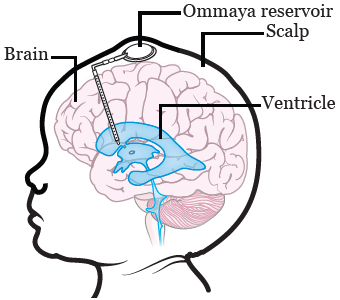
CSF Reservoir:
- A small dome-shaped device placed just under the skin on the baby’s head.
- Connected to a thin tube that leads into the fluid-filled spaces of the brain (ventricles).
- Allows healthcare providers to remove extra fluid using a needle through the skin.
- Temporary solution for hydrocephalus or high intracranial pressure.
VP Shunt (Ventriculoperitoneal Shunt):
- A more permanent device used to drain excess CSF from the brain into the belly (abdomen), where the body can absorb it.
- It includes a small valve and a long tube that runs from the brain to the abdomen.
- Automatically drains fluid without needing frequent taps or procedures.

Why Would My Baby Need One of These?
Your baby’s care team may recommend a CSF reservoir or VP shunt for conditions such as:
- Post-hemorrhagic hydrocephalus: Fluid buildup after bleeding or an “intraventricular hemorrhage” or “IVH” in the brain (often seen in very premature infants).
- Congenital hydrocephalus: A condition present at birth where the brain produces too much CSF fluid or has trouble draining it.
- Infections like meningitis or other brain injuries that block fluid flow.
CSF Reservoirs Are Often Used First
In the NICU, babies are often too small or sick for surgery right away. A reservoir allows for temporary control of pressure and fluid buildup. If the hydrocephalus doesn’t resolve, a VP shunt may be placed later when the baby is stronger and bigger.
What Are the Differences Between the Two?
| Feature | CSF Reservoir | VP Shunt |
|---|---|---|
| Type | Used Short-Term | Used Long-Term |
| How Fluid Is Removed | Manual needle tap | Automatically drains into belly (abdomen) |
| Surgery Needed? | Yes (for placement) | Yes (for placement and more complex surgery) |
| Follow-Up Needs | Frequent reservoir taps by Neurosurgery or NICU staff | Regular monitoring for function or problems with Neurosurgery |
| Transition | May be replaced by a VP shunt later | Intended as a long-term solution |
Preparing for Discharge
If Your Baby Has a CSF Reservoir:
- You’ll be taught to watch for signs of increased pressure like vomiting, fussiness, or a bulging soft spot (fontanelle).
- Your baby will need frequent follow-ups with neurosurgery to decide if a VP shunt is needed later.
- Most babies with reservoirs are not discharged home with them, but it depends on your baby’s needs.
If Your Baby Has a VP Shunt:
- You’ll receive education on how the shunt works and what to watch for:
- Vomiting
- Sleepiness
- Swelling or redness along the shunt path
- Poor feeding or irritability
- Your baby will need regular follow-up with a pediatric neurosurgeon.
- Your NICU team will give you detailed discharge instructions and help you set up appointments.
Final Thoughts
Hearing that your baby needs a reservoir or a shunt can be overwhelming—but these tools are life-saving. They help protect your baby’s developing brain by relieving pressure and preventing complications. The NICU team, including neurosurgeons and nurses, will support you every step of the way.
If you have questions, don’t hesitate to ask. You are your baby’s best advocate.
Resources:
https://choc.org/conditions/neurosurgery/hydrocephalus/
https://www.brighamandwomens.org/assets/BWH/pediatric-newborn-medicine/pdfs/phvd-cpg.pdf
 NIC-TIONARY